V2M - Virtual Machine Management
Introduction
Virtualization solutions are today widely used for developments, server consolidation, or even High Performance Computing. Virtualization solution can be categorized into two different groups, according to the Goldberg studies: (i) type-I and (ii) type-II virtualization.
With type-I virtualization, the hypervisor runs directly on top the hardware. This is for example the approach selected for the implementation of Xen or VMware EXS. With type-II virtualization, the hypervisor runs on top of the host OS. For details, please refer to online documentation about system-level virtualization.
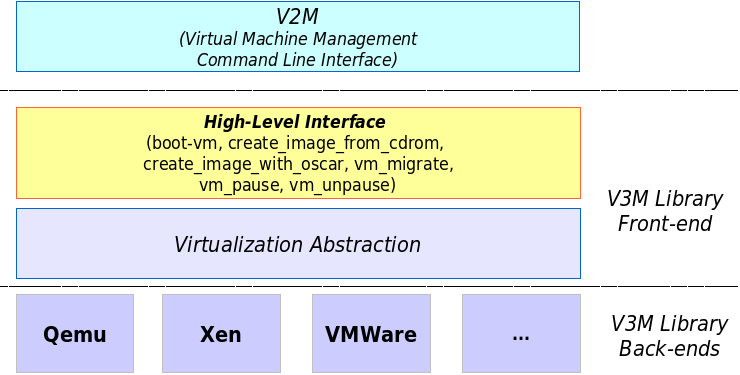
Since several virtualization solutions are today available, it is interesting to be able to switch from one solution to another, keeping the same virtual machine images and without to have to deal with technical details. V2M, Virtual Machine Management, aims to provide an abstraction for virtualization solutions. Thanks to this abstraction, users only focus on the specification of their virtual machines, V2M deals with VM's configuration and management.
For the moment, we do not try to deal with all possible configuration for each virtualization solution; we try to support common features. Therefore, few constraints exist with the current implementation:
- in order to use Xen, we should have a machine with the hardware support of virtualization (Intel-VT and AMD-V),
- the VM's image has to be a virtual disk, i.e., a disk with a partition table and so on (this is not the format that most of the Xen users are used to deal with, most of the time their images is a "flat file" which includes a single virtual partition).
The advantage of that approach is to allow users to "share" images between QEMU and Xen for instance without to have to rebuild the image. We plan to support more specific options for each virtualization solutions in future releases, allowing advanced users to use non-default options.
V2M Architecture
V2M Usage
In order to have the v2m usage, please execute v2m --help, after installing v2m.
Download
This project is actually organized in two different tasks: libv3m, a library that implements mechanisms for virtual machine management; and V2M, a command line interface (CLI) for libv3m. To download libv3m and V2M, please go to the download page.
Developer Resources
A forge is also used for the developments: http://scicompforge.org/libv3m. Note that you have to be an V2M or libv3m developer to be able to access the forge. A track system is available which is common for libv3m and V2M. Two different SVN repositories are available:
- A subversion repository for libv3m is available here.
- A subversion repository for V2M is available here.
News
- 30 October, 2008: a new version of libv3m and V2M has been released, v2m-0.9.5 and libv3m-0.9.5. This is still a development version, in preparation of the 1.0 version. V2M and libv3m can be downloaded here. Change logs are available in the source tarball.
- 09 November, 2007: a new version of libv3m/v2m is available (version 0.9.4) which fixes many bugs. V2M and libv3m can be downloaded here. Change logs are available in the source tarball.
- 26 October, 2007: a new version of libv3m and V2M has been released, v2m-0.9.1 and libv3m-0.9.1. Note that this release is still consider as a development version, in preparation of the 1.0 version. V2M and libv3m can be downloaded here. Changelogs are available in the source tarball.
